
When an air conditioner stops working, most people call for AC repair. Sometimes that’s right. Often it isn’t, because the unit is fine and the problem is on the electrical side, where a breaker has tripped, a disconnect has failed, or a circuit was never sized properly for the load in the first place.
We’re electricians, not HVAC contractors, and that turns out to be useful here. We can tell you which half of the problem you have before you pay anyone to look at the other half.
Key Takeaways
- An AC that won’t start is often an electrical fault, not a mechanical one, and the first checks take about five minutes.
- Your system usually has two circuits: a 240-volt one for the outdoor unit and a 120-volt one for the indoor air handler or furnace.
- A breaker that trips repeatedly on an AC circuit is a warning, not an inconvenience. Stop resetting it.
- Some symptoms point clearly at wiring, others at the equipment itself. Knowing which is which saves a wasted service call.
- Older West Chicago homes frequently have panels that were never sized for central air, let alone central air plus everything added since.
Start With the Breaker
Your central air system almost always runs on two separate circuits. The outdoor condenser is on a 240-volt double-pole breaker, which looks like two breakers joined together. The indoor air handler or furnace blower runs on its own 120-volt circuit.
Both need to be on. It’s common for one to trip while the other stays live, which produces confusing symptoms: the thermostat lights up and the fan runs, but nothing outside kicks on and no cold air arrives.
Open your panel door and look for a breaker sitting between on and off, or fully off. Reset it once, firmly to off first, then back to on.
If it trips again, stop. Do not keep resetting it. A breaker tripping on an AC circuit usually means one of three things: the compressor is drawing far more current than it should as it fails, there’s a fault in the wiring or the disconnect, or the breaker itself has worn out. All three get worse with repeated resets, and the third one is genuinely dangerous, because a breaker that has been cycled hard for years may eventually not trip when it needs to.
Check the Outdoor Disconnect
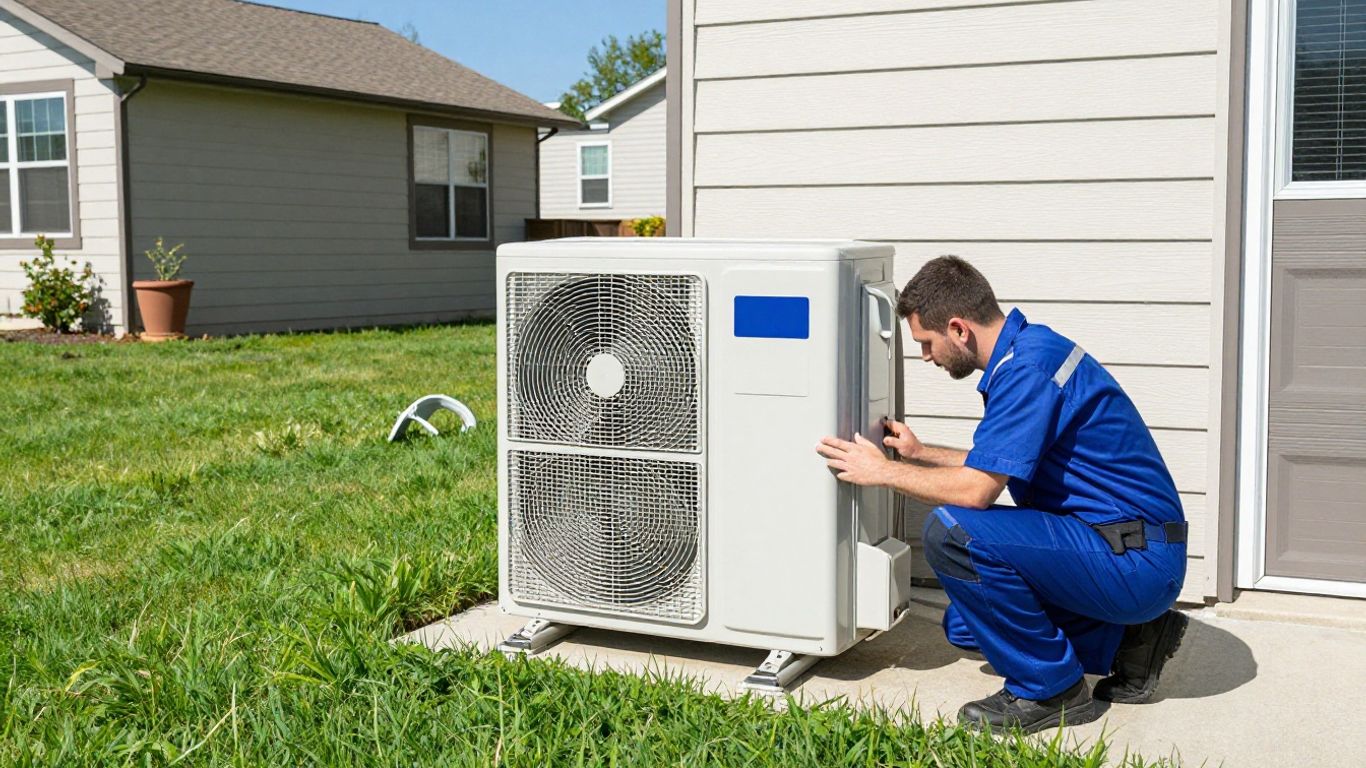
Next to your condenser there’s a small box on the wall, usually grey, roughly the size of a paperback. That’s the disconnect, and code requires it to be there so anyone servicing the unit can cut power without going back to the panel.
Inside is either a pull-out block or a small breaker. Two things go wrong with it regularly.
It gets pulled and not replaced. Somebody servicing the unit, painting the siding, or doing landscaping pulls the block and forgets to push it back. Look at it. If it’s out, or seated crooked, that’s your answer.
It corrodes. These boxes sit outdoors through Chicago winters for twenty years. Water gets in, the contacts corrode, and eventually the connection fails or becomes intermittent. An intermittent disconnect is the source of a lot of “it works some days” complaints.
Look at the box from the outside. If you see rust streaks, a cover that no longer closes properly, scorch marks, or a burnt smell, don’t open it. Shut the breaker off at the panel and call us. A failing disconnect is a common cause of AC problems and it’s straightforward to replace.
The Thermostat Is Electrical Too
Before assuming the worst, rule out the cheapest possibility.
If your thermostat is battery-powered, replace the batteries. A thermostat with dying batteries can display normally and still fail to send the signal that starts the system.
Check it’s set to Cool rather than Heat or Off, and that the fan is on Auto. Obvious, and it’s the answer often enough to be worth ten seconds.
There’s also a switch worth knowing about. Most furnaces and air handlers have a service switch nearby that looks exactly like an ordinary light switch, often on a joist or a wall in the basement. People flip it while looking for a light and don’t connect the two events. If your indoor unit is completely dead, find that switch and check it.
One more that catches people out: if your system has a condensate float switch and the drain has clogged, the switch cuts the system deliberately to stop water overflowing. That’s the system protecting your ceiling, not an electrical fault.
Signs the Problem Is Electrical
These point toward wiring, the breaker, or the disconnect:
- Nothing at all happens. No hum, no click, no fan. Complete silence usually means no power is reaching the unit.
- The breaker trips the moment you reset it, before the system has run for any length of time.
- The house lights dim noticeably every time the AC tries to start, particularly if it’s got worse over a season.
- The system works intermittently with no pattern, cutting out and returning on its own.
- You smell hot plastic near the disconnect, the panel, or the indoor unit.
- The disconnect box or a breaker feels warm to the touch.
- Other things on the same circuit stopped working at the same moment.
The last four are not wait-and-see items. Heat and burning smells mean a connection is failing right now, and a failing connection in a 240-volt circuit is a fire risk. Shut off the breaker and call an electrician.
Signs It’s the Equipment, Not the Wiring
We’d rather tell you this than take a service fee to discover it:
- The outdoor unit hums but the fan doesn’t spin. Classic failing capacitor. That’s HVAC work.
- You hear a click and then nothing, repeatedly. Usually the contactor or the compressor’s start components.
- The system runs but the air isn’t cold, or is only slightly cool. Points at refrigerant or airflow.
- The indoor coil has frozen into a block of ice. Airflow or refrigerant, not electrical.
- It runs constantly without reaching the set temperature. Sizing, refrigerant, or ductwork.
Capacitors, contactors, refrigerant and coils are HVAC territory. We don’t work on them, and we’ll tell you plainly when that’s what you’re looking at rather than sending you a bill first.
Can Your Panel Actually Handle Your AC?
This is the question that comes up most often in older homes around here, and it’s the one people discover at the worst moment.
A central air condenser is a substantial load, and the moment it starts, it draws several times its running current for a second or two. In a house with adequate service, you never notice. In a house on 100-amp service with a full panel, a finished basement, and a couple of things added over the years, you notice every time as a dimming of the lights.
Warning signs your electrical system is being asked for more than it can give:
- Lights dim across the house whenever the AC starts
- Breakers trip on hot days specifically, when the AC runs longest
- The panel has no free spaces and existing circuits have been doubled up
- You’re still on 100-amp or, in some older homes, 60-amp service
- The panel is a Federal Pacific Stab-Lok or a Zinsco, both of which have documented histories of breakers failing to trip
If you’re planning to replace an AC system, get the electrical checked first. A new condenser may need a different circuit size than the one it’s replacing, and finding that out on installation day means either a delay or a compromise. We run a load calculation and tell you whether an electrical panel upgrade is genuinely needed or whether your existing service is fine.
We see this most in the older housing around West Chicago, Villa Park and Lombard, where the wiring predates central air by decades and the panel has been absorbing new loads ever since.
What Not to Do
Don’t open the disconnect box. Even with the breaker off, there can be live parts inside depending on how it’s wired.
Don’t remove the panel cover. Everything you need for basic checks is reachable with the cover on.
Don’t keep resetting a tripping breaker. It’s protecting you from something. Resetting it repeatedly removes the protection and leaves the cause in place.
Don’t replace a breaker with a larger one. People do this to stop nuisance trips. The breaker is sized to protect the wire, and a bigger breaker on the same wire means the wire can now overheat without anything intervening.
Don’t spray the outdoor unit with a hose while it’s powered. If you’re clearing debris, kill the breaker first.
When to Call Us
Call an electrician if the breaker trips repeatedly, if the disconnect looks damaged or feels warm, if you smell burning anywhere in the system, if the lights dim badly when the AC starts, or if the unit is getting no power at all and you’ve already checked the breaker, the disconnect, and the service switch.
Call an HVAC contractor if the unit hums without starting, if the air isn’t cold, if the coil has frozen, or if it clicks and does nothing while clearly having power.
If you’re not sure which you’ve got, call us and we’ll tell you. Diagnosing which side of the line a problem falls on is a short visit, and it’s a far better outcome than paying two trades to find out.
The Bottom Line
An air conditioner that won’t start isn’t automatically a broken air conditioner. Check the breaker, look at the disconnect, replace the thermostat batteries, and find the service switch by the furnace. Those four checks resolve a meaningful share of the calls we get, and they cost nothing.
What they don’t resolve is worth taking seriously. Heat, burning smells, repeated trips and whole-house dimming are your electrical system telling you something, and on a 240-volt circuit those warnings deserve a response.
We’re a licensed electrical contractor based in West Chicago, working across DuPage and Kane County and the areas we serve. Estimates are free and there’s no obligation. Call (630) 451-9616 or get in touch here, and you can read our Google reviews to see what your neighbors have said about the work.
Frequently Asked Questions
Why does my AC breaker keep tripping?
Usually one of three causes: the compressor is drawing excessive current as it fails, there’s a fault in the circuit or the outdoor disconnect, or the breaker itself has worn out after years of cycling. Resetting it repeatedly makes all three worse. Have it diagnosed instead, because a breaker that has been stressed for years may eventually fail to trip when it matters.
Where is my AC disconnect and what does it do?
It’s the small box mounted on the wall near your outdoor condenser, containing either a pull-out block or a small breaker. It lets anyone servicing the unit cut power without going to the panel. Two common failures: someone pulls the block and doesn’t replace it, or the contacts corrode after years of weather exposure, which produces intermittent operation.
My thermostat has power but the AC won’t come on. Is that electrical?
It can be. The thermostat typically runs on a different circuit from the outdoor condenser, so a working display tells you nothing about whether the condenser has power. Check the 240-volt breaker for the outdoor unit and the disconnect outside. Also look for a service switch near the furnace that looks like an ordinary light switch, because those get flipped by accident.
Why do my lights dim every time the air conditioner starts?
A brief flicker at startup is normal, since a compressor draws a large inrush current for a moment. A pronounced dim across the whole house, or one that’s got worse over time, suggests your service or a connection isn’t comfortably handling the load. It’s worth a load calculation, particularly in older homes still on 100-amp service.
Do I need an electrician or an HVAC contractor?
If the unit is completely dead, the breaker trips, the disconnect looks damaged, or you smell burning, start with an electrician. If it hums without starting, clicks and does nothing, blows air that isn’t cold, or the coil has frozen, that’s HVAC. If you can’t tell, we’ll diagnose which side it is.
Will my electrical panel handle a new air conditioner?
Not always. A replacement condenser may require a different circuit size than the old one, and older homes here are frequently still on 100-amp service with a full panel. Getting a load calculation done before the installation is scheduled avoids finding out on the day, when the options are a delay or a compromise.